

Until 2015, I worked in the non-profit sector, and honestly, I wasn’t very aware of Hispanic Heritage Month. It just wasn’t on my radar.
That changed once I started Yucalab. My first client was actually Mundo Lanugo, a kids’ entertainment brand that celebrated Latinos across the U.S. all year round, not just in September. Between that and other movements I got involved in from there, networking with Latino professionals and with brands who take the Hispanic market seriously, this month started to matter more, for me and for my business.
Every September 15 since, my inbox, my LinkedIn, my other social profiles, and my own calendar fill up with events and conversations tied to this month. I’ve even been part of panels and workshops during this month of celebration organized by important organizations and brands.
Tomorrow it starts again, the 2026 edition. Realizing how much I’ve talked about Hispanic Heritage Month on LinkedIn, compared to almost nothing here on the blog, is exactly why I wanted to write something more foundational for anyone who doesn’t fully know this month yet. What we celebrate. Why we celebrate it. How we celebrate it. Why, especially for brands, the relationship can’t stop on October 15. The connection to the Hispanic market has to keep being built the other eleven months too.
What Is Hispanic Heritage Month?
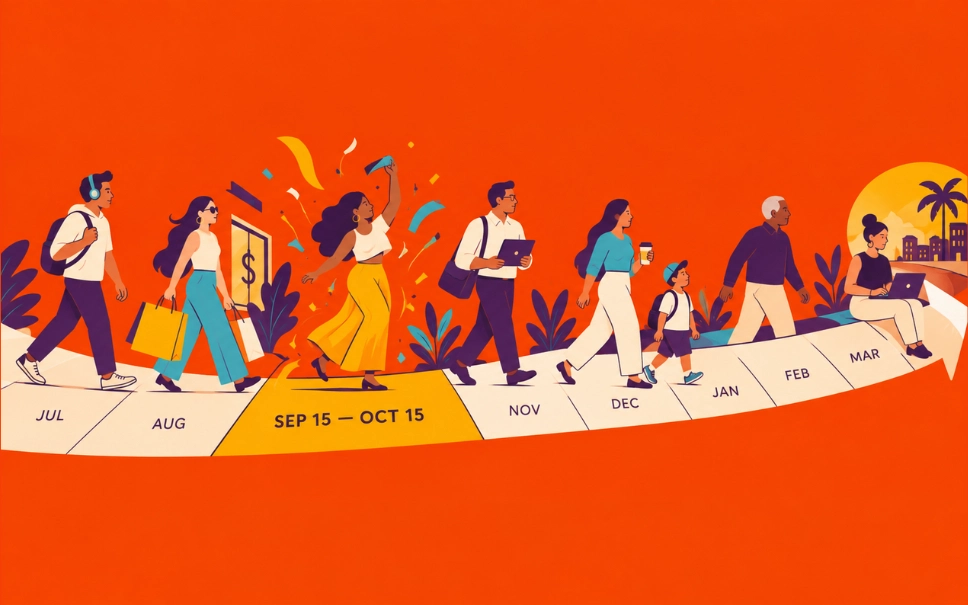
Hispanic Heritage Month is a national observance running from September 15 to October 15 every year.
It recognizes the history, culture, and contributions of Hispanics and Latinos whose roots trace back to Spain and 19 countries and territories across Latin America and the Caribbean.
It’s not a single-day holiday. It’s a 30-day window built into the federal calendar, with its own history, its own annual theme, and its own reason for landing exactly where it does.
Why Does Hispanic Heritage Month Start in September?
The date isn’t arbitrary. September 15 marks the independence anniversaries of five Central American countries at once: Costa Rica, El Salvador, Nicaragua, Guatemala, and Honduras. Mexico follows the very next day, September 16. Chile marks its independence on September 18. The 30-day window then stretches into mid-October to include what’s observed in the U.S. as Columbus Day or, increasingly, Indigenous Peoples’ Day. In much of Latin America, the same date is called Día de la Raza, though several countries now call it something else entirely, like Día de la Resistencia Indígena.
The observance itself started smaller than it is today. President Lyndon B. Johnson established it as Hispanic Heritage Week in 1968. President Ronald Reagan expanded it to a full month in 1988, signed into law as Public Law 100-402.
What Is the Theme for Hispanic Heritage Month 2026?
The official 2026 theme is “Unidos, Somos Más”, translated as “Together, We Are More.” It was created by Meleny Gomez and Kirby Quiles-Brown for the National Council of Hispanic Employment Program Managers (NCHEPM), the body that leads the annual process of selecting the federal theme and poster used by agencies, schools, and organizations nationwide.
Themes change every year and tend to circulate online well past their actual year, so it’s worth double-checking before you use one. The 2025 theme was “Collective Heritage: Honoring the Past, Inspiring the Future.” The 2024 theme was “Pioneers of Change: Shaping the Future Together,” a phrase that still shows up mislabeled as the current one on more than a few sites.
Here’s an honest observation! I rarely see brands actually use this theme. Plenty of companies write their own campaign language for the month instead. NCHEPM’s version is the one considered official at the federal level, the one federal agencies, schools, and many organizations reference every year. It’s just not usually the one you’ll find printed on a brand’s own Hispanic Heritage Month campaign.
Hispanic Heritage Month Facts
A few numbers worth knowing heading into the month:
- There are more than 68 million Hispanic individuals in the United States, about 19.5% of the total population.
- Hispanic consumers account for 22% of total U.S. consumer spending, a share larger than the population itself.
- The median age among Hispanics is 32.1, more than a decade younger than the median age of 43.2 among White Americans.
- 68% of Hispanics speak Spanish at home, while 71% also speak English proficiently. Bilingual isn’t the exception here, it’s closer to the norm.
- Bad Bunny won Album of the Year at the 2026 Grammy Awards, the first time a Spanish-language album has taken that category.
Hispanic, Latino, or Latinx: What’s the Difference?
All three terms describe roughly the same population, but they come from different places and land very differently depending on who you ask.
Hispanic refers to people with origins in Spain or Spanish-speaking countries, technically tying the term to language and Spain’s colonial history.
Latino (and Latina) refers to origin in Latin America regardless of language, which is why Brazilians are generally considered Latino but not Hispanic.
Latinx emerged more recently as a gender-neutral alternative to Latino and Latina, part of a broader push toward gender-neutral language across several languages.
Here’s where it gets interesting: the term with the least usage inside the community is the one most commonly used to talk about the community. According to Pew Research Center, only 4% of U.S. Hispanics actually use Latinx to describe themselves, even though awareness of the word has climbed to 47%. When Hispanic adults are asked which term they prefer overall, 52% to 53% say Hispanic, 26% to 29% say Latino, and just 2% say Latinx. Among people who have heard of Latinx, 75% say it shouldn’t be used to describe the population at large.
Latine is a newer, Spanish-friendlier alternative gaining ground in parts of Latin America, since the “x” in Latinx doesn’t have a natural pronunciation in Spanish. It remains far less known in the U.S. than Latinx.
When Hispanic adults are asked which term they prefer overall, 52% to 53% say Hispanic, 26% to 29% say Latino, and just 2% say Latinx.
None of these terms has fully replaced the others, and that’s unlikely to change soon. Knowing the distinction matters more than picking a side.
How Brands Celebrate Hispanic Heritage Month
The visible version of Hispanic Heritage Month, the one that fills up social feeds every September, is only part of what actually happens. A lot of the real work companies do during this month never shows up in a public post at all.
Employee resource groups (ERGs) are where much of it lives. Companies with an established Hispanic or Latino ERG often use this window to run internal workshops, bring in outside cultural organizations, and create space for employees to connect with their own history on company time, not just company dollars.
We’ve seen this firsthand. In 2025, we worked alongside HACR (the Hispanic Association on Corporate Responsibility) to transcreate a workshop into Spanish for Best Buy’s UNIDOS employee resource group. We sat in on the session itself and watched the group’s engagement with the facilitator, Yai Vargas, in real time. It’s exactly the kind of internal programming that makes a real impact on a company’s Hispanic and Latino employees. In fact, we know Best Buy is one of the companies that works on this not just during this month, but throughout the year.
Beyond ERG programming, the more common approaches include:
- Spotlighting Hispanic and Latino employees or leadership through internal and external storytelling
- Partnering with Hispanic-serving nonprofits or scholarship funds
- Supporting Hispanic-owned suppliers and vendors
- Releasing culturally relevant products or limited collaborations tied to the month
- Working with a Hispanic marketing agency to reach the market with real cultural context
How to Celebrate Hispanic Heritage Month
Whether you’re doing this as a company or on your own, a few things make it stick beyond the month itself:
- If you’re a company without an ERG, consider starting one. If you already have one, invest in it year-round: real campaigns, internal communications, actual budget, not just a workshop in September.
- Celebrate and promote your Latino employees, not only this month.
- If you’re an employee, connect with the ERG or ask if one exists. Most of the meaningful programming during this month happens there, not on the company’s social accounts.
- Go past the surface-level posts. Learn about a specific country’s cultural preferences and celebrations. Avoid Latino coating, generic content that treats every Hispanic country and culture the same.
- Support Hispanic and Latino-owned businesses directly. We put together a whole list of ways to do this a couple of years ago on Instagram, and most of it still holds up: shop local, leave real reviews, hire Hispanic and Latino professionals for services you already need, recommend the businesses you love to people who’d actually use them. None of that has to wait for September, and none of it stops at a like or a share.
- Read or watch something made by Hispanic authors, directors, or artists that has nothing to do with the observance itself.
- Carry at least one of these habits past October 15.
That last point matters more than people think. Hispanic Heritage Month is a real and useful starting point. But it’s one window into a community that shops, celebrates, and shows up every day of the year, not just these thirty.
If you’re a brand or a company looking to reach the Hispanic market, or to strengthen the relationship you already have, with your audience and with your own employees, and you’re not sure how or where to start, we’d love to talk. Let’s build a strategy together. Contact us!